Our Blog

Three Valuable Dental Treatments

April 29th, 2014

In our office, we customize treatment for every patient. Amid all of the fillings, crowns, and veneers, we find there are three treatments that are most valuable when offering our patients options: dental implants, bite guards, and teeth whitening.

Dental implants are a great tool for those who have lost teeth from trauma, genetic predetermination, decay, or fracture. Technology and design have allowed these implants to look and function like a natural tooth. They are a great investment when maintaining bone structure and smile presentation.

In our fast-paced lives, people take their stress and tension out on their teeth. Clenching and grinding, or bruxism, is on the rise. This is traumatic to crowns, fillings, and natural teeth. Headaches are a symptom of bruxism and when not treated, jaw joint inflammation and pain are a result. Bite guards are often worn at night when most of the action occurs. Many are not even aware of this habit until presented with evidence of cracked teeth, broken crowns, and pain.

Last, but most definitely not least, is whitening. Tooth whitening is safe and effective. There are different types of tooth whitening: in-office, custom trays, and over-the-counter strips. Each is effective, though at different levels. First, and your best option, is done in the office. The gums are protected and a gel with high potency is applied to the teeth. Some methods have a light shining on teeth and some have timed intervals without the light. Next are custom trays, which require an impression of your bite. Trays are picked up at a later date. At that point, instructions are given and the gel and trays are delivered. A final option is whitening strips, which can be found in many local stores. They are effective, though the whitening process is slower and some areas may not whiten.

Each treatment has risks and rewards that should always be considered prior to any treatment. Implants must be well cared for. Bite guards must be an accurate fit and worn regularly. Comfort is most important. Whitening causes temporary sensitivity and some people’s teeth whiten better than others.

Consider what your needs are, and then customize your wants to fit into the equation. A little stability from implants, protection from a bite guard, and a brilliant smile may be just what the doctor ordered. And if you have any questions, don’t hesitate to call our office, Pediatric Dental Associates.


Earth Day

April 22nd, 2014

The idea for Earth Day was the brainchild of Gaylord Nelson, a senator from Wisconsin. He envisioned an Earth Day that would be a kind of environmental teach-in. The first Earth Day celebration took place on April 22, 1970, and a surprising 20 million people participated on that day. Ultimately, it became the largest organized celebration in US history.

Earth Day Over the Years

Over the years, the recognition of the day, and the number of people celebrating it all over the world, turned Earth Day into an international celebration. Because it is celebrated throughout the world, it is not only the largest international environmental observation, but it is also more widely celebrated than any other environmental event in the world. Today, Earth Day is celebrated in 175 countries where over 500 million people participate in celebrations.

The Earth Day Movement

The Earth Day movement is credited with developing the idea that people should “think green”. It encouraged congress to enact laws, including one that resulted in the creation of the Environmental Protection Agency. It also inspired the passage of the Endangered Species Act.

The Five R's and Their Importance

  • Reduce – Reduce by avoiding unnecessary purchases. Reduce your use of materials that wind up in landfills. Reduce the use of chemicals around your house. Reduce your use of disposable bags, plates, cups, eating utensils, and batteries.
  • Reuse – Instead of using plastic bags for your groceries or purchases, bring your own reusable bags. When you go to buy coffee at Starbucks, take a travel mug so you don't have to get your coffee in a disposable paper cup. Instead of storing food in disposable refrigerator containers, buy containers that can be washed and reused. Don't use regular batteries. Whenever possible, opt for rechargeable batteries that you can reuse.
  • Recycle – Most cities offer a recycling program to collect used bottles, cans, and newspapers. Recycling includes collecting recyclable materials that would otherwise be considered waste, sorting and processing recyclables into raw materials such as fibers and manufacturing raw materials into new products.
  • Re-buy – Make an effort to purchase things that are made through recycling. When purchasing furniture, look for items that are made from reclaimed wood. When buying paper for kids school work, computer printer paper, holiday cards, or anything else, make a point of purchasing recycled paper products. Instead of buying clothing at full retail price, shop for second hand clothing. You will save a lot of money by doing so!
  • Rethink – Rethink the way you do things so that you do them in an eco-conscious way at all times. Instead of driving to work alone, consider taking the bus or going in a carpool. Walk or ride your bike when you're only going a short distance. Plan your shopping trips and errand runs so that you can do everything on one day, and do it in a way where you can save time and gas.

Other ways to "think green" include growing your own food, composting yard waste and food scraps, or by participating in local recycling programs. Join a group like Freecycle so you can share your unneeded and unwanted possessions with people who can use them. Likewise, you'll be able to get things you need or want for free.

Earth Day teaches people that the planet belongs to everyone, so everyone is equally responsible for protecting it. Although Earth Day is an environmental celebration, our team at Pediatric Dental Associates wants to remind you that you don't have to wait until then to make changes that will allow you and your family to live a greener life.

Happy Earth Day from the team at Pediatric Dental Associates.

Teeth Grinding: Not just a bad habit, but a dental concern

April 15th, 2014

Perhaps you don't even know you grind your teeth. Maybe a spouse or loved one woke you up in the middle of the night and made you aware of what was happening.

For many people, teeth grinding is a habit and a mechanical reflex; when they’re awakened and informed they were grinding their teeth, they have no recollection of it at all. According to the American Dental Association, this is the nightly situation for roughly ten percent of Americans. From young children to the elderly, teeth grinding, known in the dental community as bruxism, is a serious concern.

Many people who grind their teeth in their sleep have no idea they're doing it. In fact, when they wake up in the morning they feel no jaw pain and their teeth are fine: if it hadn’t been for someone telling them about it, the teeth grinding would have gone unnoticed.

There are other people, however, who wake up with jaw pain, shoulder and neck pain, and headaches. Teeth grinding can cause a host of dental complications. From cracked teeth and receding gums to a misaligned jaw, teeth grinding is not something to take lightly.

Preventive measures are the key to combating bruxism, and a visit to Pediatric Dental Associates can set you on the path to a healthy and safe night sleep.

The Reasons for Teeth Grinding

There are many reasons for teeth grinding. For some people, it’s a habit they acquired when they were a child and never grew out of. On the other hand, some research claims that the condition is related to stress, anxiety, or some other type of psychiatric issue.

Still other studies point to everything from poor muscle control or over-eating before bed to gastro-esophageal issues. However, the root cause of the teeth grinding is less important than identifying preventive measures against it.

Common solutions to teeth grinding include:

  • Wearing a protective nightguard
  • Stress management techniques
  • Medications and muscle relaxers

When you make an appointment with Dr. Paul Engibous at our Anchorage, AK office, we will assess your situation and determine what the best course of action is. Teeth grinding is a dental concern that can cause serious health issues down the road, so be sure to take preventive measures today.

They're just baby teeth, right?

April 8th, 2014

“But they are only baby teeth; won’t they just fall out?” Our team at Pediatric Dental Associates has had these questions asked many times from parents over the years. Primary teeth, or “baby teeth,” will indeed come out eventually, to be replaced by permanent teeth as the child grows and develops. These teeth serve a great purpose as the child continues to develop and require specific care.

Because baby teeth are temporary, some parents are unenthusiastic about fixing cavities in them. This may be due to the cost or having to force a child undergo the process—especially having to receive an injection. But if a cavity is diagnosed early enough, an injection can often be avoided. More important, failure to fill cavities in primary teeth when they are small and manageable can have lasting consequences in cost and health concerns. Serious illnesses in children have been diagnosed which began as a cavity.

Primary teeth act as a guide for permanent teeth. When decay reaches the nerve and blood supply of a tooth, this can cause an abscess. Severe pain and swelling may result. At that point, the only treatment options are either to remove the tooth or to perform a procedure similar to a baby root canal. When a primary tooth is lost prematurely—to decay or a painful abscess—the adjacent teeth will often shift and block the eruption of a permanent tooth. Braces or spacers become necessary to avoid crowding or impaction of the permanent tooth.

There is nothing more heartbreaking for Dr. Paul Engibous than to have to treat a child experiencing pain and fear. To all the parents of my little patients our team strongly recommend filling a small cavity and not waiting until it becomes a larger problem such as those described above.

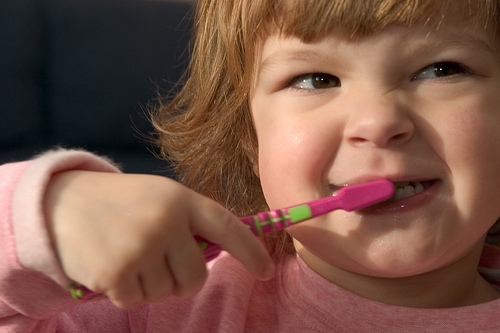
Prevention is the key to a healthy mouth for our smallest patients. Parents should allow the child to brush his or her teeth using a pea-sized amount of fluoride toothpaste and then take a turn to ensure the plaque gets removed from all surfaces: cheek side, tongue side, and chewing edges of all the teeth.